
To determine the amount of the discount, multiply the original price by the percentage of discount/100, and then subtract the discount from the original price to get the final price. For example, 20% off $90 saves $18, making the final price $72.

Discount Calculator
Apply a discount percentage, or find the discount from two prices.
Find the sale price, amount of discount and percentage of discount on any addition purchase or work backward to calculate the discount percentage between two prices instantly without any signup or registration using this free discount calculator online.
Until you’re in the store standing in the checkout line, calculating the actual price with a 20% discount, or comparing two different sales to see which one really provides a discount, it sounds straightforward. This percent discount calculator performs the calculations instantly, simply input the original price, the discount percentage, and you will know the sale price and amount saved, or input the two prices to find the discount percentage.
How to use the Discount Calculator
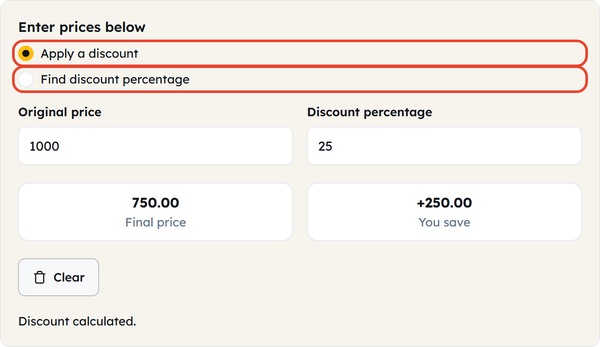
- Select the calculation: Apply a discount: you know the original price and discount %, want the final price or Find discount percentage: you know both prices, want the discount %.
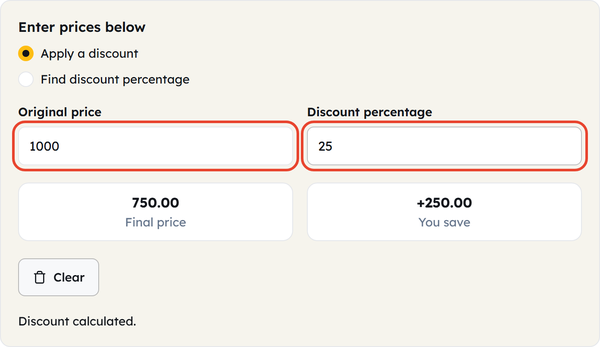
- Enter the original price and the discount percentage or final price (your choice).
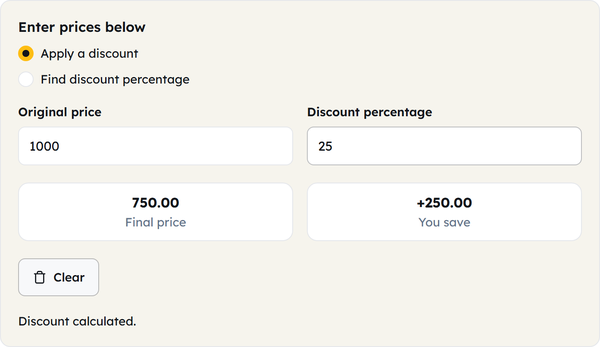
- Read out the final price and amount saved or discount percentage and amount saved.
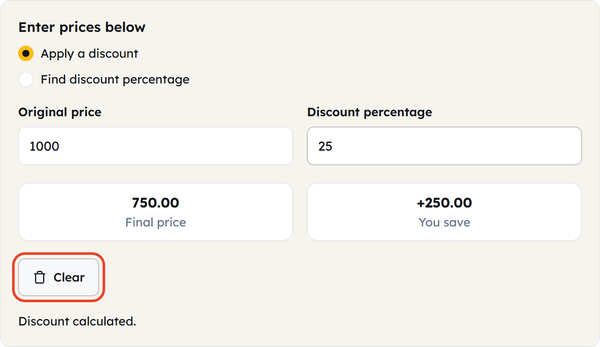
- Clear – reset the fields and recalculate.
What is a discount calculator, and how is a discount calculated?
A discount calculator simply calculates the relationship between the original price, the discount percentage and the final price, and then calculates the final price from two of the three values. The basic formula for calculating a percentage discount is:
Final price = Original price – (Original price x Discount % / 100)
Worked examples:
10% off $45 → save $4.50 → final price $40.50
20% off $90 → save $18 → final price $72
30% off $60 → save $18 → final price $42
If you know the final amount and original amount, you can find the percentage of the discount by subtracting the final amount from the original amount, then dividing by the original amount, and multiplying by 100. For example, if a $100 item is now $80, the discount is ($100 − $80) ÷ $100 × 100 = 20%.
When the discount price and discount percentage are given, the original price is calculated by taking the following steps: Take the discount percentage and divide it by 100, then subtract it from 1, and then divide the discount price by it. For example, an $80 price after a 20% discount means the original price was $80 ÷ 0.8 = $100.
A true common mistake: stacked discounts don’t just sum up. If a store has 20% off and 15% off at the cashier, then it isn’t 35% off the original price, it’s 20% off the discounted price plus 15% off the discounted price. On a $100 item, 20% off brings it to $80; a further 15% off that $80 brings it to $68 — a combined discount of 32%, not 35%. It’s a small percentage, but it does amount to a lot on a bigger purchase and it’s important to understand before assuming two stacked percentages equal a double one.
When you’d use this
Used as a sale discount calculator, it covers working out the actual price of an item on sale before checking out, seeing the difference in two different sale offers to see which really means a discount, comparing an item with the discount taken in an ad or on a price tag, determining the original price of an item when only given the sale price, or determining the effect of two stacked discounts rather than assuming they add up.
Dos and Don’ts
Do:
- When comparing two different sales, be sure to compare the actual final price, not the percentage.
- Keep in mind that stacked or combined discounts multiply, not add; re-calculate, don’t assume.
- Check a discount claim using the reverse mode, if both prices are printed on a receipt or price tag.
Don’t:
- Do not assume that 20% off + 15% off equals 35% off.
- Don’t question an advertised “was” price: some stores mark up the original price just to make it seem that the discount will be greater than the real amount.
- Mix up a discount of a fixed amount ($20 off) with discount of a percentage (20 percent off); they can behave differently, particularly at various levels of prices.
Good to know
Not all the discounted offers are really a discount. Sadly, one common method retailers use is to pad the ‘original’ price before the discount is applied, or to discount the price to what it is normally sold for, making it seem like a bigger deal than it actually is. A good way to spot this is that the person can perform the math on the claimed discount without having to rely on an itemized list or any other information, except for just the original price and final price. In isolation, discounts are applied to the existing discount, rather than to the original price; therefore, combined or “stacked” discounts will always be slightly less than the sum of the individual discounts. Whether you are working forwards from a percentage or backwards from two prices, it is the same discount off calculator doing the work. All the information on this page operates locally within your browser and the prices you enter are never sent or stored.
FAQ: Discount Calculator Questions
How do I calculate a discount?
How do I find the discount percentage between two prices?
Find the difference between the discounted price and the original price and divide by the original price, then multiply by 100. This gives the discount as a percentage.
How do I find the original price if I only know the discounted price and percentage?
Divide the discount (as a percentage) by 100 and subtract the result from 1. Then divide the discounted price by this number. For example, an $80 price after a 20% discount means the original price was $80 ÷ 0.8 = $100.
What does “stacked” or “combined” discount mean, and is it the sum of both percentages?
No. The stacked discount is not the 35% discount off the original price. The second discount is on the already reduced price, making the discount effect less than the sum of the two.
What is a fake or inflated discount?
It is a form of marketing that involves the pretend inflation of the “original” price listed before the discount, or the actual discounted price being the same as the normal market price and making the discount appear larger than it is.
Does this calculator store the prices I enter?
No. All the calculations are made in your browser, and no numbers are ever sent or stored.
Related Tools

Password Strength
Score password strength and spot weak patterns.
- 100% Free
- Customizable
- Download
- Unlimited

Percentage Calculator
Calculate percentages, increases, and decreases.
- 100% Free
- Customizable
- Download
- Unlimited
Age Calculator
Find exact age in years, months, and days.
- 100% Free
- Customizable
- Download
- Unlimited

Date Difference
Measure days between any two dates.
- 100% Free
- Customizable
- Download
- Unlimited

BMI Calculator
Compute body mass index from height and weight.
- 100% Free
- Customizable
- Download
- Unlimited

EMI Calculator
Estimate loan EMI, interest, and total payable.
- 100% Free
- Customizable
- Download
- Unlimited