
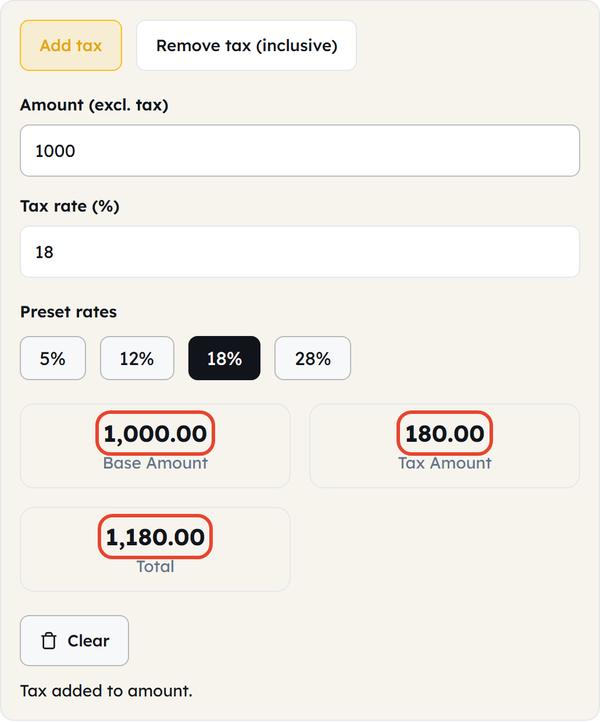
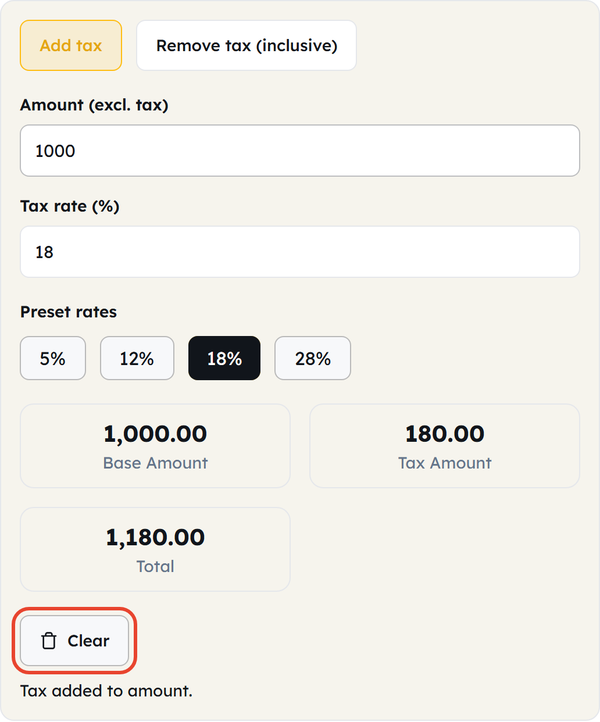
Multiply the taxable value by the GST rate and divide by 100. GST on ₹1,000 at 18% is (1,000 × 18) ÷ 100 = ₹180, making the total ₹1,180.

GST Calculator
Add GST/VAT to a net amount, or strip it out of a tax-inclusive price.
Add GST to a net price, or strip it back out of a price that already includes it — as a GST inclusive calculator it works in both directions, and running it as a reverse GST calculator gives you the pre-tax amount a total was built from. Rates depend on how the goods or service are classified: 5%, 12%, 18% and 28% are the common ones, while some supplies are nil-rated, exempt, or fall under another rate.
GST is easy to get wrong — whether you are checking a quote that already includes it, breaking an invoice down into its base amount, or working out what you actually paid before tax. This online GST calculator adds GST to a net price or removes it from a gross one, at any of the common Indian GST rates or a rate you type in yourself.
How to Use the GST Calculator
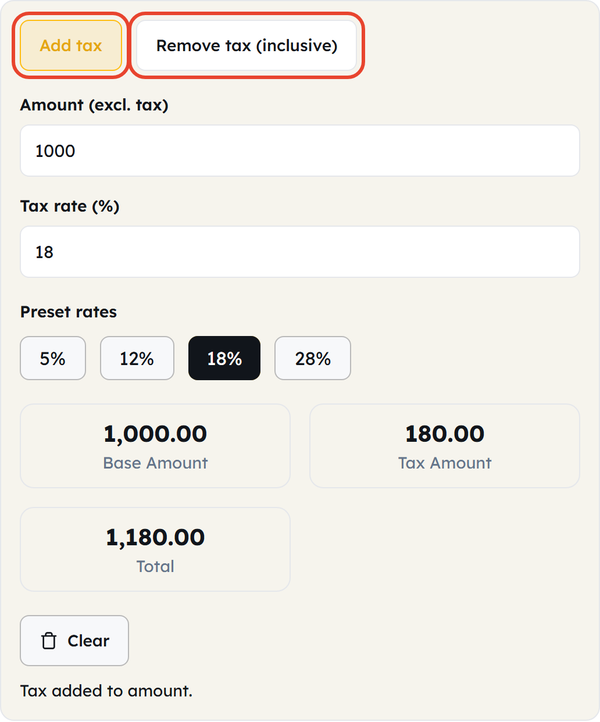
- Choose a mode: Add tax if you have a base amount and want the total, or Remove tax (inclusive) if you have a total and want the base amount and the tax separately.
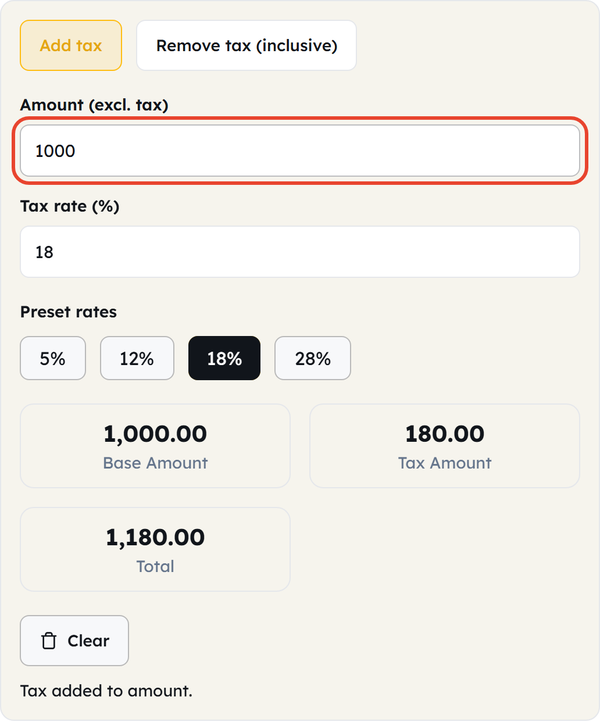
- Enter the amount. In Remove tax mode the field is labelled Amount (incl. tax).
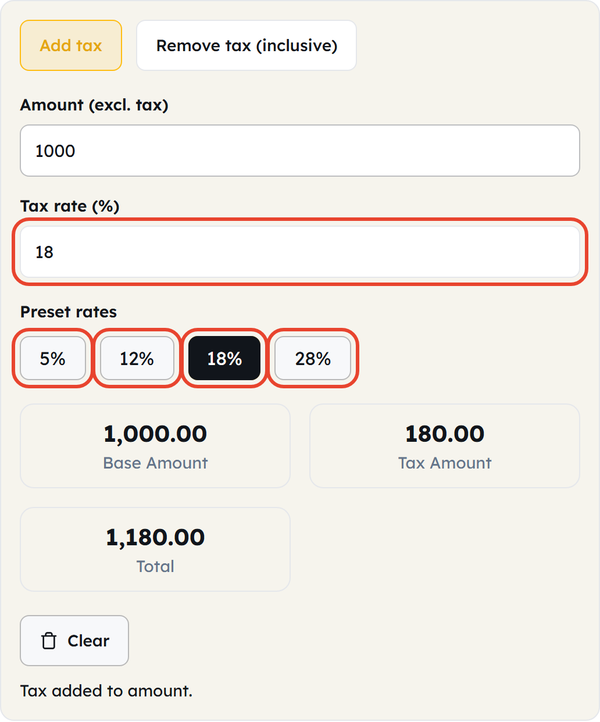
- Click a preset rate (5%, 12%, 18%, 28%) or type a custom rate into Tax rate (%).
- Read the result: Base Amount, Tax Amount and Total are shown separately.
- Click Clear to empty the fields and start again.
What Is GST, and How Is It Calculated?
Goods and Services Tax (GST) is the unified indirect tax on the supply of goods and services in India, introduced in 2017 to replace a fragmented set of central and state taxes such as VAT and excise duty. It is calculated by applying the applicable rate to the taxable value of a supply.
Adding GST to a net amount:
GST Amount = (Taxable Value × GST Rate) ÷ 100, and Total = Taxable Value + GST Amount.
Example: ₹1,000 at 18% GST → GST amount = (1,000 × 18) ÷ 100 = ₹180 → total = ₹1,180.
Removing GST from an inclusive amount:
Taxable Value = Inclusive Amount ÷ (1 + GST Rate ÷ 100), and GST Amount = Inclusive Amount − Taxable Value.
Example: a ₹1,180 total that already includes 18% GST → taxable value = 1,180 ÷ 1.18 = ₹1,000 → GST amount = 1,180 − 1,000 = ₹180.
The Standard GST Slabs
The rates in common use for goods and services in India are 5%, 12%, 18% and 28%, with some supplies nil-rated or exempt. Which one applies depends on the type of goods or service — many freelance and professional services, for example, are taxed at 18%.
CGST, SGST and IGST — Why GST Is Sometimes Split in Two
GST is collected under three heads: CGST, SGST/UTGST and IGST.
When GST is split into CGST and SGST on a bill, that is not two different rates — it is where the transaction happened. On a sale within a state the GST is split in two, CGST (Central) and SGST (State), usually half the rate each. On an inter-state sale a single IGST applies at the full rate, collected centrally. The tax you pay is the same either way; only the split and the collecting authority differ.
When You Would Use This
When you need to display the GST on an invoice and/or quote; when you check a supplier’s or vendor’s bill and need to confirm the GST charged is correct; when you work out the actual pre-tax price of a product or service that you’ve paid a price inclusive of GST for; when you compare the prices of different suppliers or vendors who quote inclusive and exclusive of GST; or when you estimate the price of a product or service before registering for GST or developing a rate card.
Do’s and Don’ts
Do
- Check whether each quote you are comparing includes GST or excludes it — comparing one of each compares the wrong numbers.
- Apply the rate slab that belongs to the particular goods or service. Rates differ by category, so check rather than assume.
- Show the base amount, the tax amount and the total on separate lines of an invoice — a GST-compliant invoice normally requires it.
Don’t
- Assume adding and removing tax are the same sum in reverse. Adding multiplies by the rate; removing divides by (1 + rate ÷ 100). They are different formulas and give different numbers.
- Treat the output as a filed return or an official invoice — this is a planning and checking tool.
- Confuse the CGST/SGST/IGST split with different rates. The rate is the same; what changes is how it is divided and who collects it, depending on whether the supply crosses a state border.
Good to Know
Adding 18% to ₹1,000 gives ₹1,180, but removing 18% from ₹1,180 is not a matter of subtracting ₹180 — you divide by 1.18 to find the ₹1,000 the tax was charged on. The two are easy to mix up, which is the main reason to use a GST calculator online rather than doing the sum in your head. If CGST and SGST/UTGST appear separately, the supply is generally intra-State; for an inter-State supply, IGST generally applies. This calculator is for general planning and checking — for filing, invoicing or compliance questions, speak to a qualified accountant or tax professional. Everything runs in your browser and no amounts are sent or stored.
Frequently Asked Questions
How do I calculate GST on a price?
How do I remove GST from a total (inclusive) amount?
Divide the total by 1 plus the rate over 100 to get the taxable value, then subtract that from the total to get the GST. A ₹1,180 total at 18% gives a taxable value of ₹1,000 and GST of ₹180.
What are the standard GST rate slabs in India?
The commonly used slabs are 5%, 12%, 18% and 28%. Some supplies are nil-rated or exempt, and the rate that applies depends on the goods or service.
What is the difference between CGST, SGST, and IGST?
For an intra-State supply, GST is generally charged as CGST plus SGST/UTGST, usually half the rate each. For an inter-State supply, IGST generally applies at the full rate. The total tax is the same either way — only the split and the collecting authority change.
Is GST calculated on the price before or after other charges?
GST is generally calculated on the taxable value of the supply. Discounts, incidental expenses and other charges can change that value, so for a specific invoice follow the applicable GST valuation rules rather than assuming every extra charge is treated the same way.
Is this GST calculator a substitute for professional tax advice?
No. It is a general calculation for planning and checking. For filing, compliance or invoicing questions, speak to a qualified accountant or tax professional.