
True random numbers come from an unpredictable physical process, such as atmospheric noise. Pseudo-random numbers come from a mathematical formula that looks random but is worked out from a starting value called a “seed”.

Random Number
Generate random numbers in any range — integers or decimals, unique or repeatable, using secure randomness.
Generate numbers between a minimum and a maximum you set — whole or decimal, one at a time or thousands at once, with repeats allowed or every number unique — drawn from your browser’s cryptographically secure random source.
Picking a raffle winner, choosing someone off a list, generating test data or just settling something by chance — if a person does the picking, it is not really random. People are poor at randomness and unconscious patterns creep in. This random number picker removes that: set the range, say how many numbers you want and whether repeats are allowed, and get a result no one can predict.
How to Use the Random Number Generator
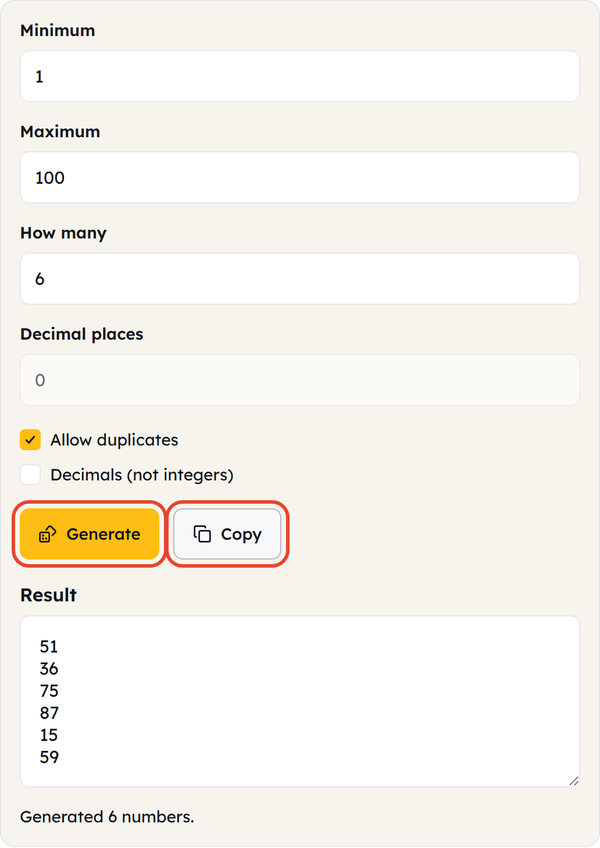
- Set the Minimum and Maximum of your range.
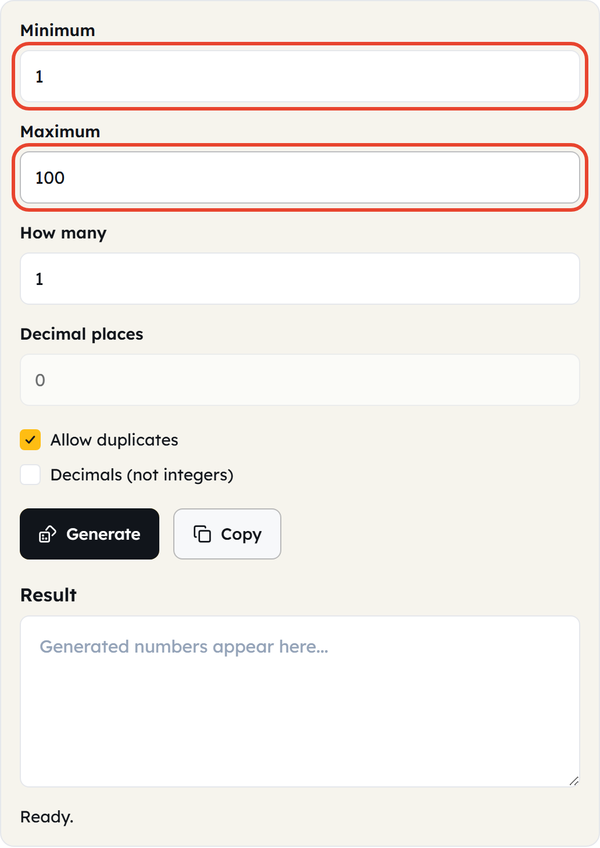
- Enter How many numbers you want.
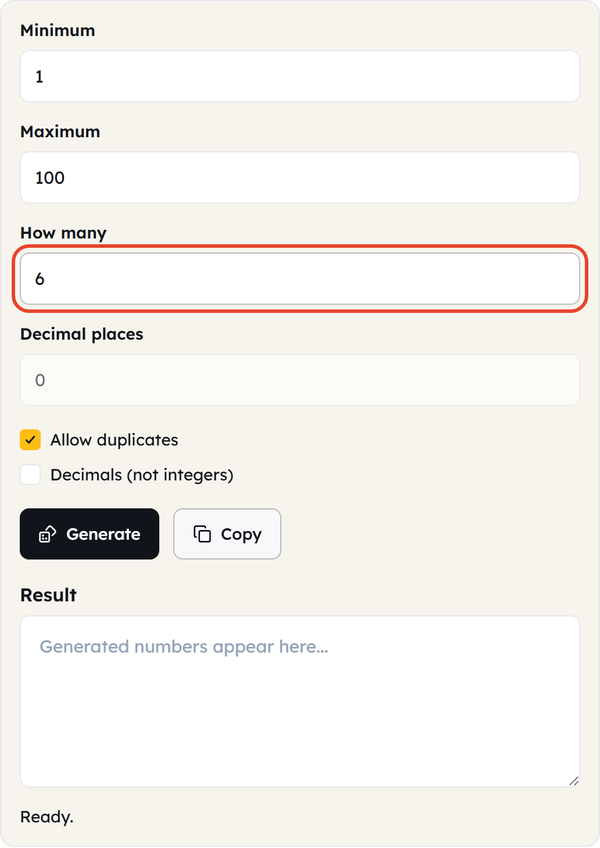
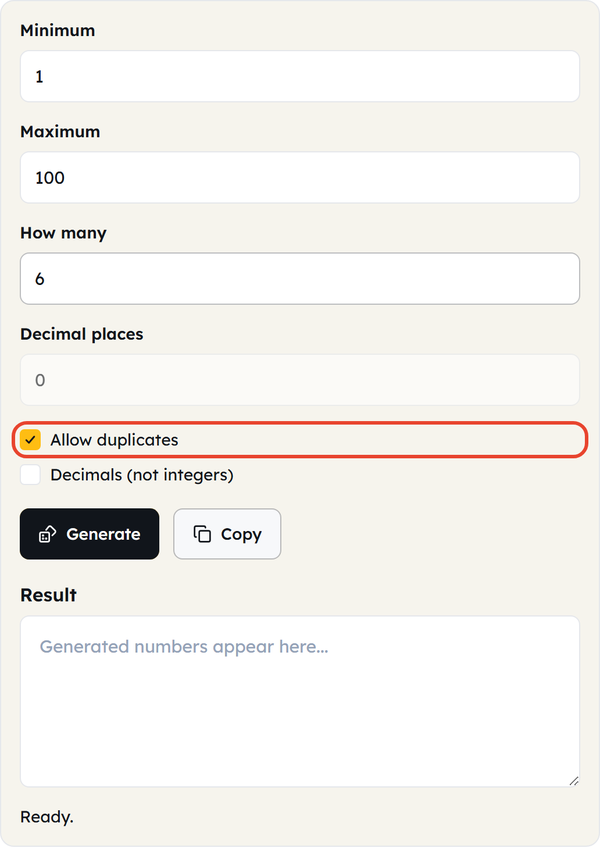
- Leave Allow duplicates ticked if the same number may come up more than once. Untick it to draw each number only once.
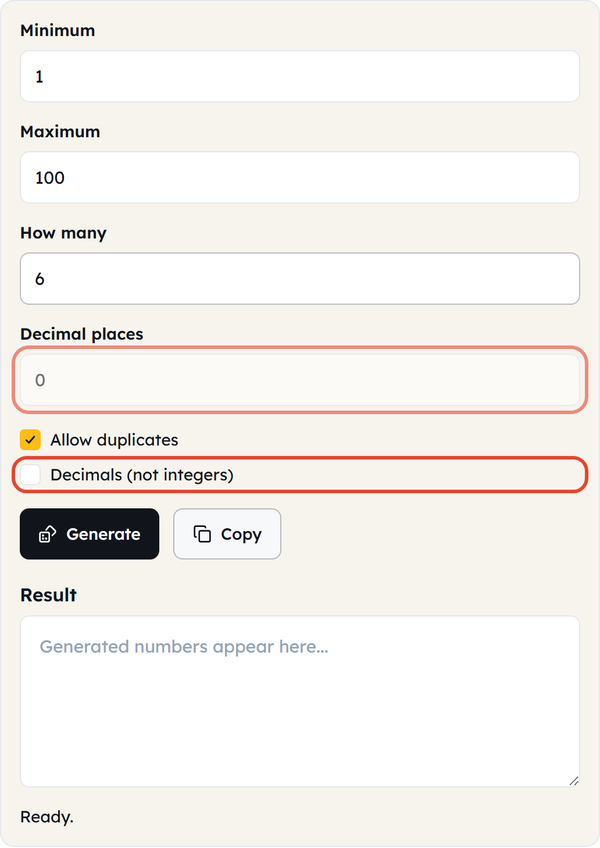
- For decimals rather than whole numbers, tick Decimals (not integers) and set Decimal places.
- Click Generate to draw the numbers, then Copy to take the result away with you.
What Makes a Number Random, and How Is It Generated?
There is more than one kind of randomness, and the difference matters whenever the numbers have to be fair as well as unpredictable.
- True randomness comes from a physical process — some services use atmospheric noise. In principle it cannot be reproduced or predicted, even from identical starting conditions.
- Pseudo-random numbers come from an algorithm that produces a sequence which looks random but can be reproduced exactly by running the same algorithm from the same starting value, or “seed”. This is what most everyday software uses, and it is fine for casual purposes but not for passwords or cryptography.
- Cryptographically secure pseudo-random numbers sit in between. They are still produced by an algorithm, but one built so that nobody can work out the next value from the ones already seen. That is what this tool uses: not true physical randomness, but unpredictable enough for fair draws, raffles and giveaways.
The duplicates setting changes how repeats behave, not how random the numbers are. With duplicates allowed, every number is drawn independently — like rolling a die several times, where the same face twice in a row is perfectly normal. With duplicates off, each number is taken out of the pool once it is drawn, so no number appears twice in the set — like drawing raffle tickets from a hat.
When You Would Use This
Running a random number draw for a raffle, giveaway or contest; drawing a random sample for statistics, research or testing; using it as a random number chooser when you would rather decide by chance than by preference; and picking numbers for a game, a puzzle or a classroom exercise.
Do’s and Don’ts
Do
- Untick Allow duplicates whenever a number must not repeat — a raffle draw, a set of unique participants, a non-repeating sample.
- Leave Allow duplicates ticked for genuinely independent events, such as repeated dice rolls, coin-flip decisions and simulations where repetition is expected.
- Check the Minimum and Maximum before you generate a large batch, especially if the draw is public.
Don’t
- Assume any random-looking sequence is good enough for a lottery or a large-scale giveaway. Where it really matters, use a source that states how its numbers are produced and check it meets your requirements.
- Read “no duplicates” as “evenly spread out”. Unique numbers are still random within the range; they simply never repeat. They will not be neatly spaced.
- Ask for more unique numbers than the range can hold — request 10 unique numbers from 1 to 5 and there simply are not enough values to draw.
Good to Know
People are remarkably bad at inventing random numbers. Asked to pick some, most of us avoid whatever we just said, favour certain digits, or drift towards a pattern — and those patterns are easy to spot, which is exactly what a proper generator avoids. If you have used the Google random number picker built into search results, this works the same way but gives you control over duplicates and decimals. It is also worth knowing that not all computer-generated randomness is equal: a simple pseudo-random algorithm is fine for something like scattering objects in a game, but it can be predicted by anyone who knows the seed. A cryptographically secure generator is built so that it cannot, and that is the kind used here and in password and encryption work. Whether to allow duplicates is a real question rather than a preference: is each number a separate repeatable event, like a dice roll, or one pick out of a fixed set that cannot repeat, like a raffle draw? Everything on this page runs in your browser and the numbers produced are never sent or saved.
Frequently Asked Questions
What’s the difference between random and pseudo-random numbers?
Is this generator’s randomness secure enough for a raffle or giveaway?
Yes. It draws from your browser’s cryptographically secure random source, which is designed so that no one can predict the next value from the ones already produced. That is not the same as true physical randomness, but it is more than fair enough for draws, raffles and giveaways.
What does “allow duplicates” mean?
With Allow duplicates ticked, every number is drawn independently and the same number can come up more than once — like rolling a die repeatedly. Untick it and each number is drawn only once across the whole set, like pulling raffle tickets out of a hat.
Can I generate decimal numbers, not just whole numbers?
Yes. Tick Decimals (not integers) and set how many decimal places you want, and the generator returns decimals within your range instead of whole numbers.
How many random numbers can I generate at once?
Type the quantity into the How many box and they all come back in one result, following your range and your duplicates setting. Thousands at a time is not a problem.
Are the numbers I generate stored or sent anywhere?
No. The numbers are generated entirely in your browser and are never sent or stored.