
Multiply the Celsius value by 9/5, then add 32. For example, 20 × 9/5 + 32 = 68°F.

Unit Converter
Convert length, weight and temperature between units — results update as you type.
This free unit converter online handles length, weight and temperature between metric and imperial units, using exact standard conversion factors, with the result updating as you type.
Whether you are working through a recipe written in a system you do not use, comparing a product spec quoted in different units, or making sense of a weather forecast in the wrong scale, unit conversion is one of the small daily frictions of a world that never quite standardised. This converter covers the three people reach for most — length, weight and temperature — instantly, and with exact factors rather than approximations.
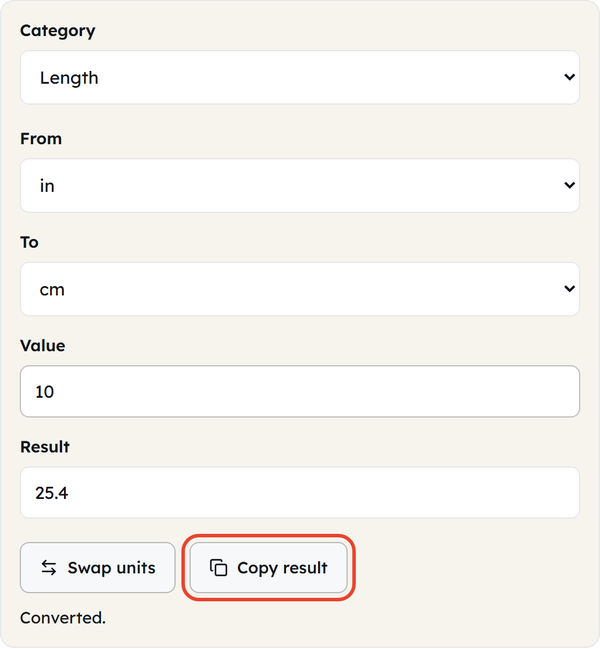
How to Use the Unit Converter
- Pick a Category: Length, Weight or Temperature.
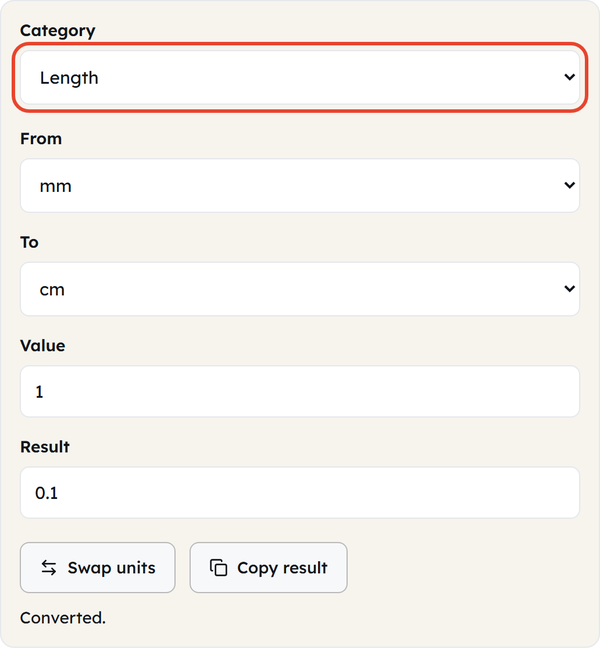
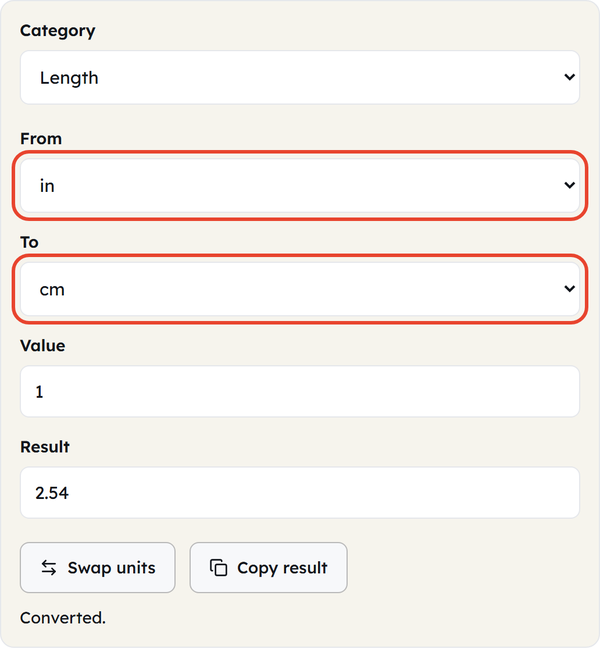
- Choose the unit you are converting From and the unit you want To.
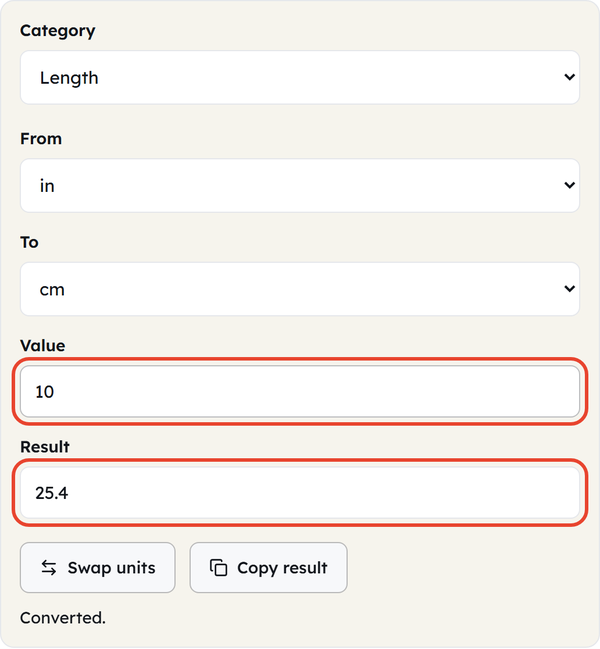
- Type the number into Value. The Result updates as you type.
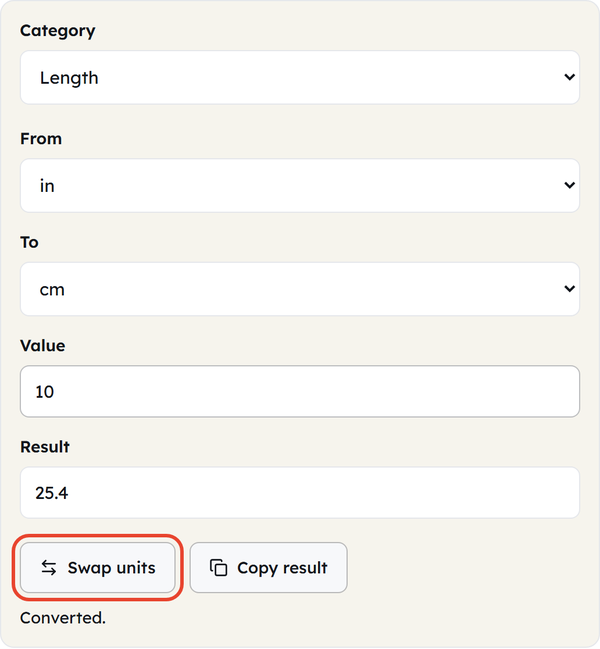
- Click Swap units to reverse the direction of the conversion.
- Click Copy result to put the converted value on your clipboard.
What Is a Unit Converter, and How Accurate Is It?
A unit converter applies a fixed, known relationship between two units. For length and weight that is a single multiplication factor. Temperature is different: the scales start from different reference points as well as using different intervals, so converting between them needs an addition or subtraction as well as a multiplication.
Length conversion factors (relative to 1 metre):
- 1 inch = 0.0254 m
- 1 foot = 0.3048 m
- 1 yard = 0.9144 m
- 1 mile = 1,609.344 m
Weight conversion factors:
- 1 ounce = 28.349523125 g
- 1 pound = 453.59237 g
- 1 tonne = 1,000,000 g
- 1 kilogram = 1,000 g
Temperature formulas:
- Celsius to Fahrenheit: °F = °C × 9/5 + 32
- Fahrenheit to Celsius: °C = (°F − 32) × 5/9
- Celsius to Kelvin: K = °C + 273.15
- Kelvin to Celsius: °C = K − 273.15
- Fahrenheit to Kelvin: K = (°F − 32) × 5/9 + 273.15
- Kelvin to Fahrenheit: °F = (K − 273.15) × 9/5 + 32
The converter uses internationally defined conversion factors. Results are rounded only for display, to the number of decimal places shown.
Commonly Searched Conversions
| Conversion | Example |
|---|---|
| Celsius to Fahrenheit | 20°C = 68°F |
| Kilograms to pounds | 1 kg ≈ 2.20462 lb |
| Inches to centimeters | 10 in = 25.4 cm |
| Feet to metres | 6 ft ≈ 1.83 m |
| Pounds to kilograms | 150 lb ≈ 68.04 kg |
When You Would Use This
Converting ingredient quantities or oven temperatures between metric and imperial, checking your own height or weight in the other system for an international form, a fitness app or a medical context, converting a distance before travelling, for DIY or for study, or reading a forecast given in a temperature scale you do not think in.
Do’s and Don’ts
Do
- Check a conversion in both directions with the swap button — it takes a second.
- Confirm which system a form, recipe or spec sheet expects before you enter a converted value. Most require one or the other, and they are easy to mix up.
- Use exact factors, like the ones in this tool, rather than mental arithmetic whenever accuracy matters — cooking, construction, medicine.
Don’t
- Assume a rough mental conversion (“just double it” for kg to lb) is close enough for anything precision-sensitive. It is an estimate, not an exact value.
- Mix up weight units that sound alike across systems — a US ton and a metric tonne are not the same thing.
- Forget that temperature is not a straight multiplication like length or weight. The scales do not share a zero, so the formula needs an addition or subtraction too.
Good to Know
Most unit converters try to cover every specialist and scientific unit; this unit converter calculator deliberately sticks to the three categories people actually reach for — length, weight and temperature. Centimetres to inches, kilograms to pounds and Celsius to Fahrenheit account for most real-world conversions. The online converter units still cover a wide practical range: length runs from mm to miles, weight from mg to tonnes and pounds, and temperature covers Celsius, Fahrenheit and Kelvin. Temperature is the one that behaves differently: because Celsius and Fahrenheit do not share a zero, converting between them takes an addition or subtraction as well as a multiplier. Everything on this page runs locally and nothing you type is sent or saved.
Frequently Asked Questions
How do I convert Celsius to Fahrenheit?
How many pounds are in a kilogram?
There are about 2.20462 pounds in 1 kilogram. The converter uses the exact standard factor (1 lb = 453.59237 g), so 1 kg comes back as 2.204623 lb.
How do I convert inches to centimeters?
Multiply by 2.54. For example, 10 inches × 2.54 = 25.4 centimetres.
Why are there different unit systems like metric and imperial?
Units of measurement grew up separately in different regions. Metric is the international standard almost everywhere, but a few countries still use imperial or US customary units, so converting between the two is a routine job.
Are the conversion factors used here accurate?
Yes. The converter uses internationally defined factors such as 1 inch = 0.0254 metres and 1 pound = 453.59237 grams. Results are rounded only for display.
Is my data stored or sent anywhere when I use this converter?
No. The conversion runs in your browser and nothing is uploaded or saved.