
Like most grammar and writing tools, it looks for sentence-ending punctuation (periods, question marks, and exclamation points).

Sentence Counter
Count sentences and average length as you type.
Long sentences can make even a modest word count feel heavy. The Sentence Counter analyzes your text, calculates your average sentence length, and highlights your single longest sentence. It provides a fast readability check before publishing.
Paste your draft in and get all four numbers instantly, updated as you edit.
How to Use the Sentence Counter Tool
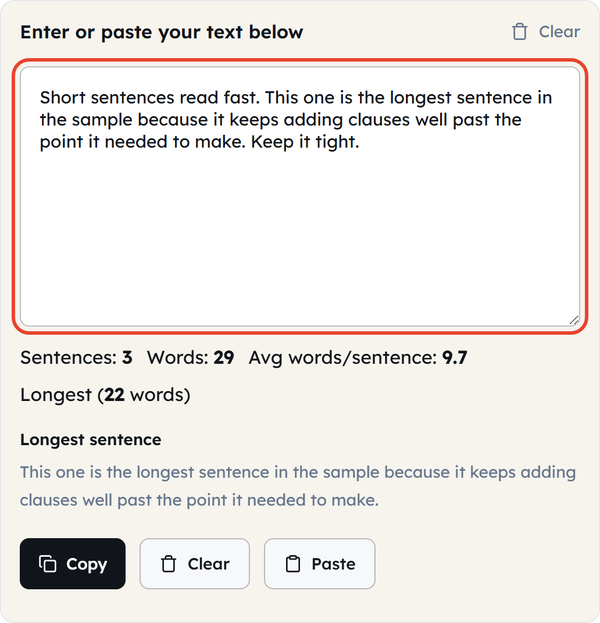
- Type or paste your text in the input box.
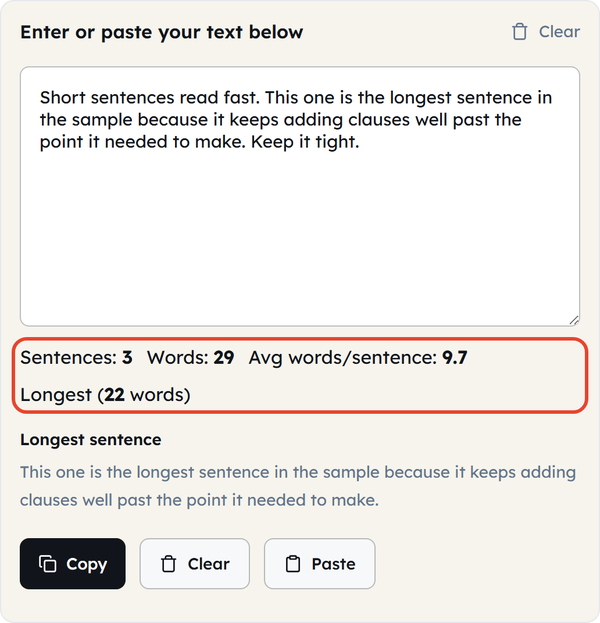
- See real-time results: Sentences, Words, Avg words/sentence and Longest sentence.
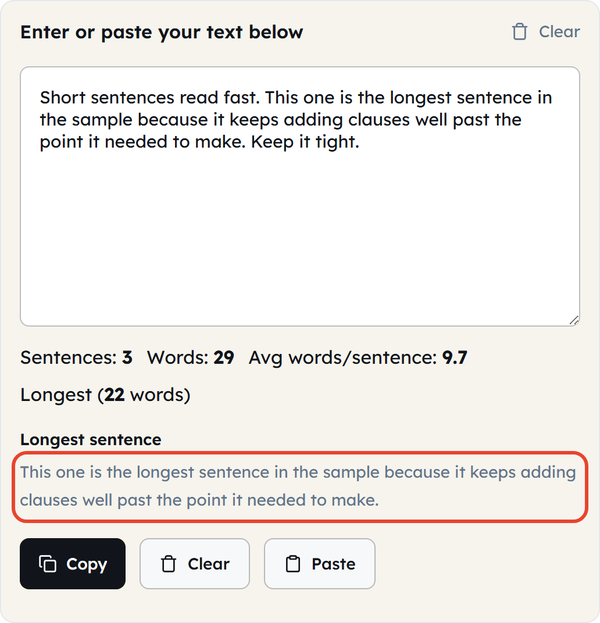
- Check the flagged “Longest Sentence” below the counts to pinpoint what needs trimming.
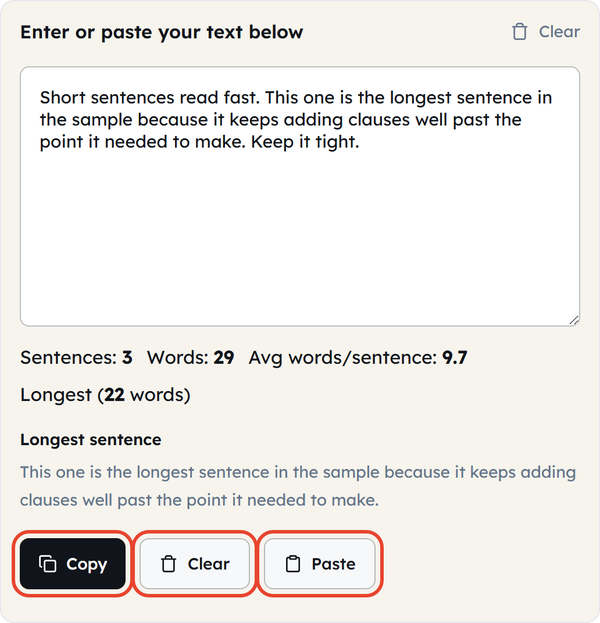
- Use Paste to drop text in from your clipboard, Copy to export it, or Clear to start fresh.
What Is Sentence Count?
Sentence count is the number of sentences in a piece of writing; it is usually counted by the number of sentence-ending punctuation marks, such as periods, question marks, and exclamation points.
On its own, it is a basic measure. Combined with word count, it’s a great readability indicator. Dividing your total words by your total sentences gives you the average sentence length—one of the most common and reliable indicators of how easy your writing is to follow.
This tool goes a step further than a plain counter by surfacing your single longest sentence. While your average sentence length might be good, one long, rambling sentence can slow the pace of an entire paragraph.
When Should You Use a Sentence Counter?
- Publishing: To run a quick readability check before creating a blog or article.
- Academics & Business: Editing essays/reports with overly complex sentences.
- Client Work: Backing editing recommendations with objective numbers when proofreading client documents.
- Marketing: Editing copy where short, punchy sentences drive higher conversions.
- Formatting: Checking your work against a style guide’s or brief’s sentence-length limits.
- Pacing: Comparing sentence structure across different sections of a longer document.
Sentence Counter Best Practices: Do’s and Don’ts
| Do | Don’t |
|---|---|
| Check the longest sentence for any awkward language. | Stick to one “ideal” average for all formats and audiences. |
| Use the average as a guide, but manually read flagged sentences. | Trust counts around abbreviations blindly; counters can occasionally miscount them. |
| Recheck your stats after making even minor edits. | Assume shorter is always better; complex ideas sometimes need length. |
What You Should Know About Sentence Length
- One of the primary factors in most readability scores, such as the Flesch Reading Ease score or Flesch-Kincaid Grade Level, is the average sentence length – the shorter the sentences, the higher the reading-ease score.
- Even if most of your sentences are short, one very long sentence will raise your average — which is exactly why the longest-sentence readout is worth checking.
- Sentence fragments count as sentences here when they include sentence-ending punctuation, as is common in blogs and marketing copy.
- Dialogue tends to pull the average down, since quoted sentences are often short and numerous — especially in fiction.
How Sentence Length Affects Readability
There’s no single correct sentence length, but average length is a strong general indicator of how easy it is to read a piece:
| Avg. Words/Sentence | General Feel | Best For |
|---|---|---|
| 8–12 words | Easy, fast-reading | Blog posts, marketing copy, social media |
| 13–18 words | Moderate, standard prose | News articles, general web content |
| 19–25 words | Denser, more formal | Business reports, academic writing |
| 25+ words | Heavy, harder to follow | Legal or technical documents |
These are guidelines, not rules: good writing deliberately mixes short and long sentences rather than holding one length throughout — variety keeps the rhythm interesting, not robotic.
Frequently Asked Questions (FAQs)
How does the tool know where one sentence ends and another begins?
Can abbreviations like ‘Mr.’ or ‘e.g.’ throw off the count?
Sometimes, a space following the abbreviation may resemble the end of a sentence. If you have more counts than you think you should, look for abbreviations followed by a capital letter; this is the most common reason for a false split.
What counts as the ‘longest sentence’?
The single sentence in your text with the most words. The tool displays it with its word count so you can find and edit it.
Is there an ideal average sentence length?
There’s no single universal number; it varies with your target audience and your particular type of content. Shorter sentences work well for web and marketing copy, while longer sentences are normal in technical or academic writing.
Do semicolons, colons, or em-dashes split sentences?
No. Semicolons, colons, and em-dashes do not end a sentence — only terminal punctuation (., !, ?) does.
How much text can I paste at once?
As much as you like — paste a paragraph or a whole article and the counts update immediately.
Related Tools
Character Counter
Track characters with or without spaces in real time.
- 100% Free
- Customizable
- Download
- Unlimited
Paragraph Counter
Measure paragraphs and structure at a glance.
- 100% Free
- Customizable
- Download
- Unlimited
Case Converter
Convert text between upper, lower, title, and more.
- 100% Free
- Customizable
- Download
- Unlimited
Remove Extra Spaces
Clean double spaces and tidy whitespace fast.
- 100% Free
- Customizable
- Download
- Unlimited
Remove Line Breaks
Flatten text by stripping unwanted line breaks.
- 100% Free
- Customizable
- Download
- Unlimited
Remove Duplicate Lines
Deduplicate lines while preserving order.
- 100% Free
- Customizable
- Download
- Unlimited