
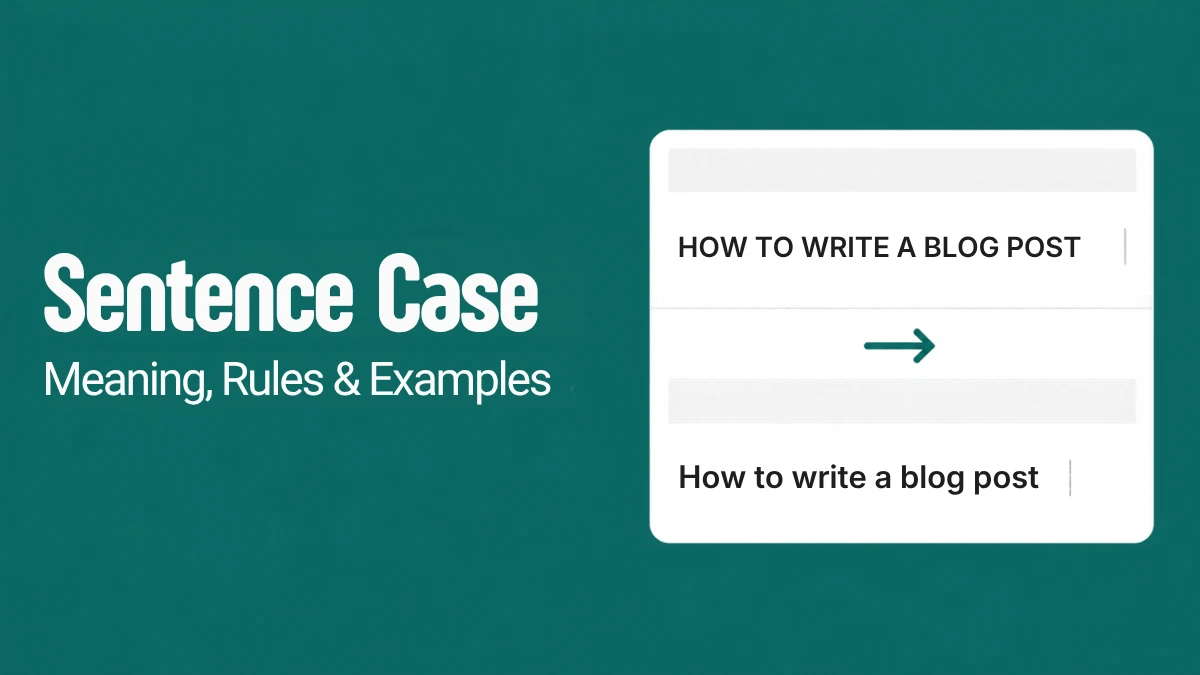
This refers to sentence case, where the first word in the sentence is capitalized, but most others are in lowercase except those that should be capitalized because of their nature.
Sentence Case: Meaning, Rules, Difference with Title Case, and Examples
Sentence case is an important part of written content, whether it is an article, paragraph, or any heading. It is one of the most common cases writers use.
 ToolHub Admin
Published On: November 4, 2026
Sentence case is an important part of written content, whether it is an article, paragraph, or any heading. It is one of the most common cases writers use.
This guide will help you understand its rules with examples and the major differences between title case and sentence case, to give you a better understanding of the topic so you can decide accordingly. Let’s begin…….
What Is Sentence Case?
Sentence case refers to a style of capitalization whereby the first letter of a sentence is capitalized, but the rest of the words in the sentence are left in lowercase unless there is a word that needs capitalization. You can spot sentence case format in various places, including:-
- Blog headings and article titles.
- Academic papers and research writing.
- Website headings and navigation labels.
- Reports and business documents.
- Instructions and informational content.
- Captions, descriptions, and user-interface text and more.
Sentence Case Capitalization Rules
Before we move towards the examples for better understanding, let us discuss some rules that we have to keep in mind while applying sentence case to our content.
- Capitalize the first word
- Keep most other words in lowercase
- Capitalize proper nouns
- Keep acronyms and initialisms capitalized
- Capitalize the first word after a colon when required
- Follow the required style guide
Examples Of Sentence Case
Let’s have a look at some examples now:-
| Before | Sentence case |
| HOW TO WRITE A BLOG POST | How to write a blog post |
| THE BENEFITS OF ONLINE LEARNING | The benefits of online learning |
| A GUIDE TO DIGITAL MARKETING | A guide to digital marketing |
| TIPS FOR BETTER TIME MANAGEMENT | Tips for better time management |
| HOW TO USE MICROSOFT WORD | How to use Microsoft Word |
| BEST PRACTICES FOR SEO | Best practices for SEO |
| LEARNING ENGLISH FOR BEGINNERS | Learning English for beginners |
| HOW TO CREATE A WEBSITE WITH WORDPRESS | How to create a website with WordPress |
Sentence Case Vs Title Case: What Is The Difference?
When writing, people prefer one of the cases depending on the requirements, and these cases are the common cases among writers. Let’s discuss key differences quickly, as we already had a look at some examples.
| Feature | Sentence case | Title case |
| First word | Capitalized | Capitalized |
| Main words | Usually lowercase | Usually capitalized |
| Articles | Lowercase unless first | Often lowercase |
| Short prepositions | Lowercase unless first | Usually lowercase, depending on style |
| Proper nouns | Retain capitalization | Retain capitalization |
| Common use | Sentences, headings, academic titles | Book titles, article headings, formal titles |
Here are some examples for better understanding:-
| Sentence case | Title case |
| How to write better content | How To Write Better Content |
| A guide to digital marketing | A Guide To Digital Marketing |
| Tips for improving your website | Tips For Improving Your Website |
| The benefits of online learning | The Benefits Of Online Learning |
| How to use a text editor | How To Use A Text Editor |
When Should You Use Sentence Case?
Sentence case is applicable when you are looking for simplicity and consistency in your text format. This type of case is effective in digital texts and documents where the heading should be natural instead of overly formal. We mentioned some situations where this case can help:-
- Blog posts and website headings
- Academic writing
- Business documents and reports
- Website interfaces and navigation
- Instructions and guides
When Should You Use Title Case Instead?
Sentence case can help you anywhere, but title case may be required in some situations, like:-
- A publication follows a title case heading convention.
- You are formatting a book or report title according to a specific editorial style.
- A brand’s style guide requires title case.
- A particular assignment or publication asks for title case.
- You want headings to follow a more traditional appearance for styling titles.
How To Convert Text Into Sentence Case
Converting every word from upper case to lower case manually can take a lot of your time; that’s why, to save time, you can use an online tool that reduces the chance of mistakes by a lot compared to a human.
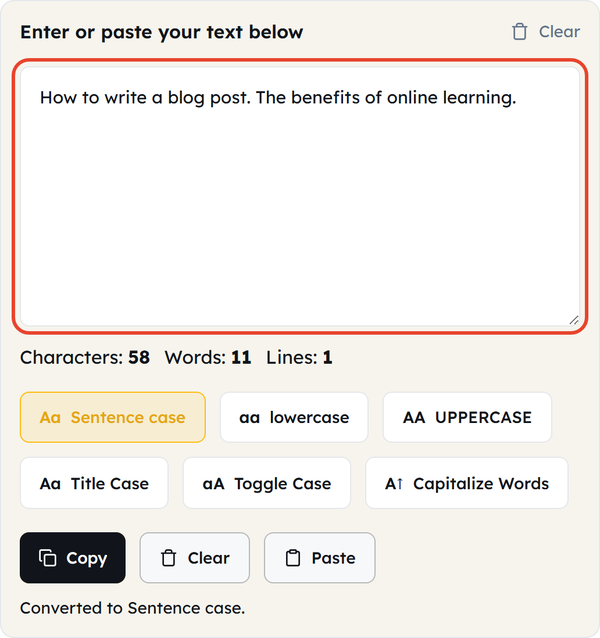
ToolFlora’s Case Converter can help you with these simple steps to follow when using the tool:-
- Open the case converter.
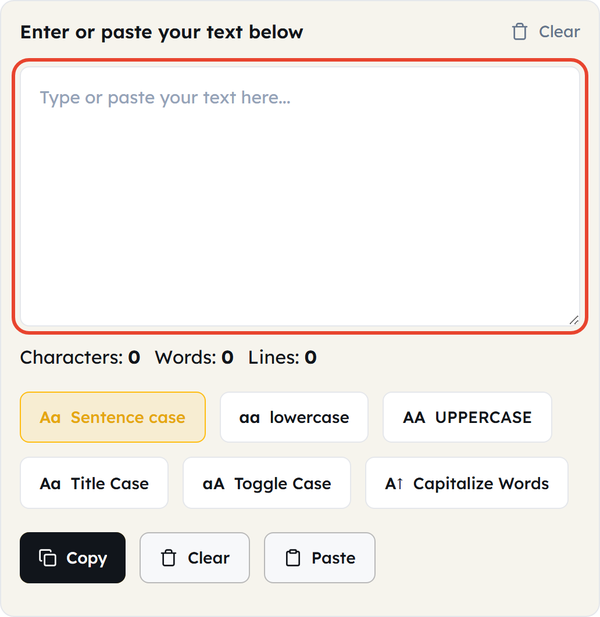
- Enter the text
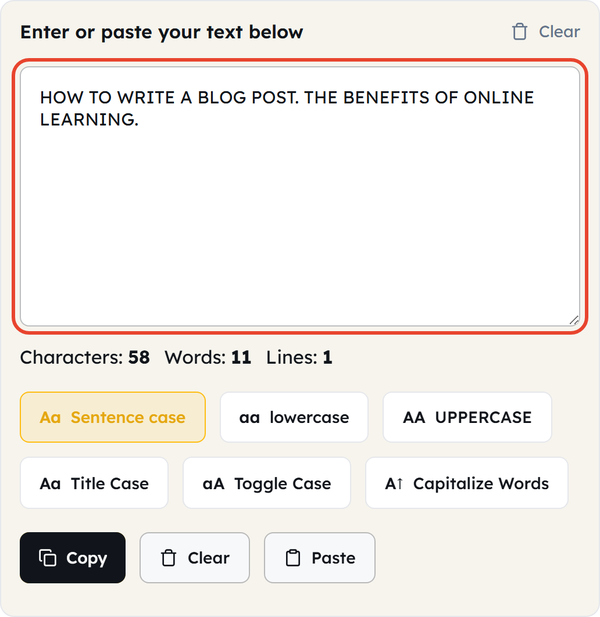
- Choose sentence case
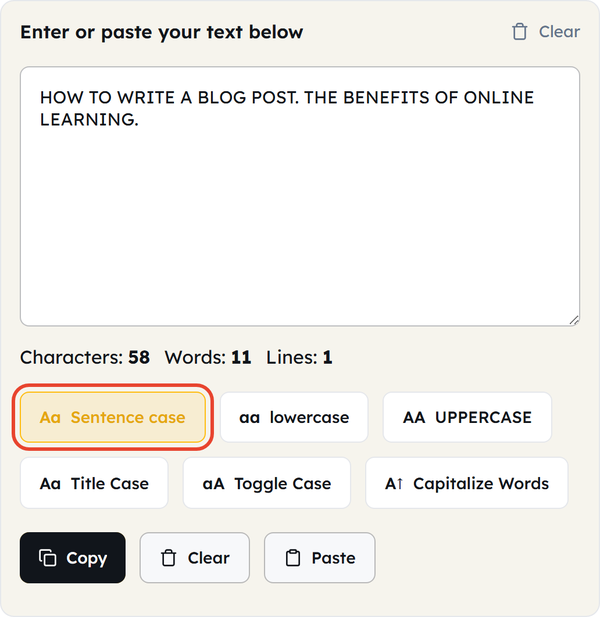
- Review the result
- Copy your text
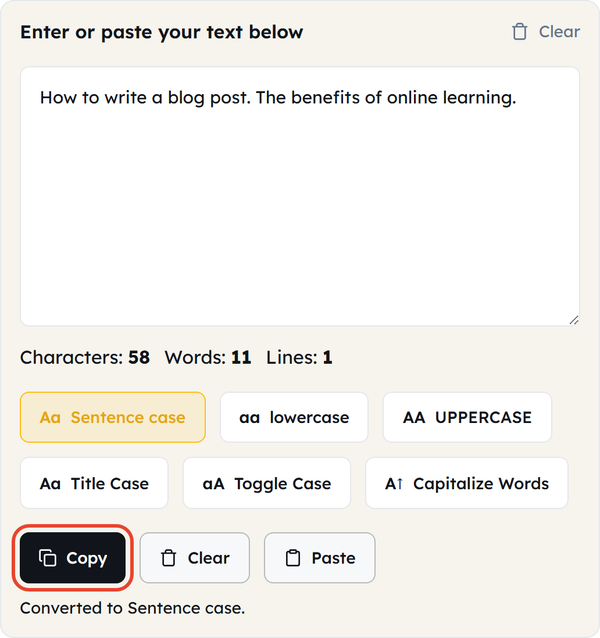
And that’s it….
Common Sentence Case Mistakes To Avoid
Some mistakes can make your text feel inconsistent, so you’d better avoid them. Those mistakes are:-
- Making every word lowercase
- Capitalizing every main word
- Forgetting to capitalize the first word
- Changing acronyms to lowercase
- Ignoring style guide requirements
Tips For Using Sentence Case Consistently
To fix the mistakes or to enhance your text, here are some tips that can do so:-
- Choose one style
- Follow a style guide
- Check proper nouns
- Keep acronyms unchanged
- Review headings
- Use a case converter
- Avoid unnecessary capitalization
Frequently Asked Questions
1. What is sentence case?
2. What is the difference between sentence case and title case?
In sentence case, the first word and those words that need to be capitalized are capitalized. In title case, all significant words in a title are capitalized based on the guidelines of the particular style manual.
3. Is sentence case the same as lowercase?
None. Sentence case puts the first letter of each sentence in capital letters, along with other proper nouns and acronyms. Lowercase makes all letters lowercase, including the first letter.
4. Should headings be written in sentence case?
Sure, sentences can be used for creating headings. It is often done for headings on websites, blogs, and other types of documents. Nonetheless, use the necessary writing style if there is any.
5. Does sentence case capitalize proper nouns?
Absolutely. Names of persons, countries, organizations, as well as any other proper nouns remain capitalized regardless of where they fall within the sentence.
6. Is sentence case used in APA style?
Yes. The APA format requires the use of sentence case in some types of titles, such as those in reference list entries. The specifics will depend on the type of source material.
7. Should the word after a colon be capitalized in sentence case?
It depends on the rules of the particular style guide being followed. There are instances when certain style guides require capitalization of the first word following a colon.
8. Can I convert title case into sentence case automatically?
Yes. You could rely on an online case converter to convert title case to sentence case. You would have to check your converted text for any errors in capitalization of proper nouns, acronyms, and other specific terms.
9. Is sentence case better than title case?
It all depends on the specific context and the purpose of your writing. Neither of these two cases is better than the other.
10. Where is sentence case commonly used?
The use of sentence case can be found in blog post headings, web interfaces, various business documents and reports, instruction manuals, and so forth.
Conclusion
Sentence case is one of the simplest capitalization styles, making the writing appear consistent and natural. This type of capitalization involves capitalizing the first word of a sentence or a heading, whereas the rest of the words are kept in lowercase, except those that should be capitalized according to the rules.
The differences between sentence case and title case allow you to make the right choice regarding the capitalization style depending on the situation, whether you are writing a blog post, a heading on your website, an academic paper, or any other professional text.
If you often deal with text, ToolFlora’s Case Converter will help you convert the capitalization style without changing all the words manually.
Related Blogs
 How Many Pages Is 1000 Words? A Complete Words-To-Pages Guide
While writing an essay, school assignment, blog post, report, or script for anything, a question might strike your mind: how…
 Title Case: Rules, Meaning, and Examples for Correct Title Capitalization
Title case is a common style that we give to specific words based on the content, whether for titles of…
 Plus minus symbol (±): Meaning, uses, and how to type it.
You may have seen this plus minus symbol somewhere, especially in places related to mathematics, and you must have wondered…