
Whenever you need to make certain major words stand out, you use title case, where the beginning letter of each word is capitalized. Smaller words, such as articles and certain short prepositions or conjunctions, often remain lowercase unless their position or the chosen style guide requires otherwise.
Title Case: Rules, Meaning, and Examples for Correct Title Capitalization
Title case is a common style that we give to specific words based on the content, whether for titles of books, articles, creative works, or other published content. It makes...
 ToolHub Admin
Published On: October 27, 2026
Title case is a common style that we give to specific words based on the content, whether for titles of books, articles, creative works, or other published content. It makes the text look cleaner and easier to read than inconsistent capitalization, which makes the content look unfinished.
This guide will cover everything about title case, including its meaning, rules, examples, and what kind of words need title case.
What Is Title Case?
Title Case is a form of capitalization in which most significant words in the title have an initial capital letter, whereas some small words are written in lowercase letters. These small words typically comprise articles, short prepositions, and coordinating conjunctions, according to the applied style manual. Examples are:-
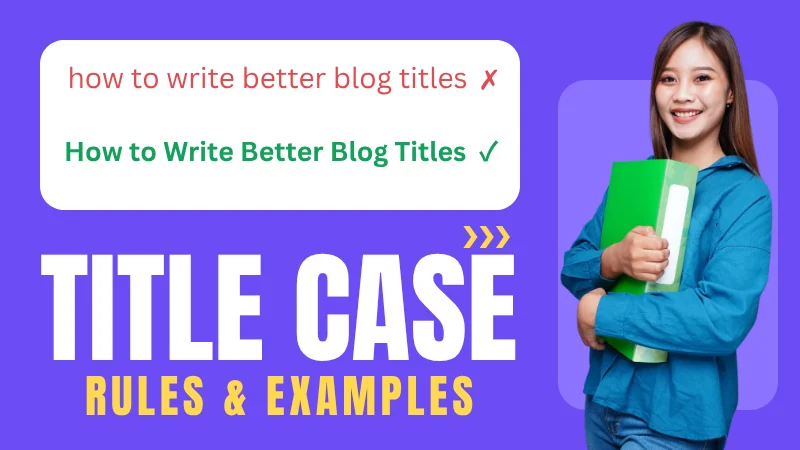
- How to write better blog titles: Incorrect
- How to Write Better Blog Titles: Correct
As you can see in the second example, the words that have capital letters at the start are the first word, verbs, nouns, and adjectives, and the others are in lowercase.
Other places where title case plays a crucial role are book titles, article headlines, website headings, presentation titles, and other related fields; this is why it is also known as headline case.
Title Case Vs Sentence Case
Title case and sentence case are just two of the ways you can change text case, so to simply understand the difference between them, here is a short comparison to decide where to use what case.
| Title Case | Sentence case |
| How To Write Better Blog Titles | How to write better blog titles |
| A Guide To Digital Marketing | A guide to digital marketing |
| The Benefits Of Reading Every Day | The benefits of reading every day |
| How To Choose The Right Writing Tool | How to choose the right writing tool |
The best way to get an understanding is to see the example comparison directly, and we can conclude that neither is better than the other, but both of them are useful depending on the publication, website, academic requirements, or editorial guidelines you need to follow.
Title Case Rules: What Should You Capitalize?
Title capitalization styles agree on how major words should be treated. The discrepancies arise from the treatment of minor words, prepositions, conjunctions, and particular compound expressions.
Below are the basic guidelines for properly capitalizing titles.
Capitalize The First Word Of The Title
Title case capitalization rules dictate that the first word of a title should be capitalized. This rule applies even when the first word would normally remain in the middle of the title in lowercase.
Capitalize Nouns
Nouns include people, places, objects, ideas, and concepts that are usually capitalized in title case, as they tell the subject of the title.
Capitalize Pronouns
Pronouns also get title case generally, which includes I, You, We, They, Who, and It. Grammatical role matters more than the length of a word to deserve title case.
Capitalize Verbs
Verbs are the actions, conditions, and states of being. Along with verbs, short verbs also get capitalized in title case.
Capitalize Adjectives And Adverbs
Adjectives describe nouns, whereas adverbs describe verbs, adjectives, or even other adverbs. Both are usually capitalized.
Usually Lowercase Articles
A, An, & The are usually lowercase when in the middle of the sentence or title but get capitalized when they appear as a first or last word at the time of title case conversion.
Usually Lowercase Short Conjunctions
The function of conjunctions is to link words, phrases, and clauses together. Coordinating conjunctions include “and,” “but,” “or,” “nor,” “for,” “so,” and “yet.” Depending on the chosen style, these conjunctions may retain their lowercase status, except when they occur at the beginning or end of the title because of specific rules for certain conjunctions.
For Hyphenated Words
When a title contains two words joined by a hyphen, it usually creates confusion about whether the second word after the hyphen should be capitalized or not. Examples that clear up this doubt:-
- The Well-Designed Website
- A Step-By-Step Guide To Better Writing
- Navigating The Work-For-Hire Process
Words to Capitalize in a Title: A Quick Reference
| Word type | General rule | Example |
| Nouns | Capitalize | Guide, Writing, Website |
| Pronouns | Capitalize | You, We, It |
| Verbs | Capitalize | Write, It, Improve |
| Adjectives | Capitalize | Simple, Effective, Useful |
| Adverbs | Capitalize | Clearly, Quickly, Well |
| Articles | Usually Lowercase | A, An, The |
| Short Conjunctions | Usually Lowercase | And, But, Or |
| Short Prepositions | Usually Lowercase | In, On, At, To |
| First Word | Capitalize | The Benefits Of Writing |
| Last Word | Usually Capitalize | Something To Write About |
Capitalization Of Prepositions In Titles
Prepositions constitute some of the most difficult words in capitalizing titles. Some of the prepositions that are used in titles include “in,” “on,” “at,” “by,” “for,” “with,” “over,” and “between.” However, whether or not they are capitalized depends on the style guide and grammatical function.
Should Prepositions Be Capitalized in Titles?
Sometimes, it depends on whether a preposition is a short one or a long one because, if it is a short one appearing in the middle of the title, it would remain in lowercase, but if it is a long one, then it may be capitalized under certain style guides.
Consider some examples giving an idea of whether to use which case for which preposition:-
- The Art Of Writing For The Web
- A Guide To Working With Digital Tools
- The Relationship Between Design And Usability
- How To Improve Your Skills In Writing
How Do Different Style Guides Treat Prepositions?
There is no universal style that would apply to any publication, but a simple comparison between styles is as follows:-
| Style guide | General treatment of prepositions |
| AP | Prepositions of four or more letters are capitalized in composition titles. |
| APA | Words of four or more letters are capitalized, including many longer prepositions. |
| Chicago | Prepositions are lowercased regardless of length |
| MLA | Major words are capitalized, including short prepositions when they function as major words under MLA rules. |
The above-mentioned are the summaries of each style intended to give the reader a starting point to go deep into each specific one.
For example, the title “The Man With the Golden Grain” adheres to the capitalization rules outlined by AP and APA, whereas the title “The Man with the Golden Grain” is in line with the rules for Chicago and MLA.
Why The Function Of A Word Matters
The function of a word matters because a simple word can serve different meanings depending on the context; such words include on, up, down, or in. Let’s have a look at an example for better understanding.
- Keep on the Sunny Side.
- Keep On Running.
See, on functions differently in both scenarios: in the first one as a preposition, and in the second one as an adverb, which is why the adverb one got capitalized.
Examples Of Title Case: Correct And Incorrect Formatting
Examples are always a better way to understand anything. Here as well, let’s have a look at some different examples.
- Example 1: Capitalizing every word
How To Write Better Blog Posts: Incorrect
How to Write Better Blog Posts: Correct
The difference is “to,” which should be in lowercase, as we can see in the correct example, as it is a short word which in many cases left lowercase in most of the title conversions.
- Example 2: Leaving short verbs lowercase
What is Title Case?: Incorrect
What Is Title Case?: Correct
Here “Is” is a verb, which should be capitalized and not left in lowercase because of fewer letters in the word.
- Example 3: Capitalizing articles in the middle
The Benefits Of A Good Writing Process: Incorrect
The Benefits of a Good Writing Process: Correct
The corrected version shows “of” and “a” in lowercase because one is a short preposition and the other is an article; that’s why.
Common Title Case Mistakes To Avoid
Even seasoned writers are capable of making capitalization errors in writing their headlines. The best method of avoiding this is by knowing the underlying purpose of the rules as opposed to learning individual cases. Some common mistakes you should be careful of while writing:-
- Capitalizing every word
- Leaving every short word lowercase
- Ignoring different style guides
- Forgetting the grammatical role of a word
- Using different styles across headings
- Using title case everywhere
How To Use a Title Case Converter
Manually checking every word in the title can take considerable time, especially when you’re preparing many blog posts or long articles with several headings. In such cases, you can use a title case converter that helps you in the process by making it easier through its automatic application of capitalization rules.
ToolFlora’s Text and Writing section would serve as a great source of information on text formatting tools. There is also the mentioned Title Case Converter.
- Step 1: Prepare your title
- Step 2: Enter the text into the converter
- Step 3: Choose the appropriate style
- Step 4: Review the result
- Step 5: Use the corrected title consistently
When Should You Use a Title Case Converter?
It is best used when your title needs to stand out, which is not always the preferred choice, but ideally, the best use is to make your title stand out. Here are some situations where it can be used as well:-
- Blog titles
The clear and consistent titles throughout the article through formatting
- Website headings
A consistent use of headings across your pages always looks good, supports the whole vibe of the website, and makes your titles easier to review with free SEO tools.
- Presentations
Make your slide titles stand out from your supporting text.
- Reports and documents
Based on your organization’s list of rules, format the headings accordingly.
- Marketing content
Keep consistency in your campaign headlines and content assets.
How ToolFlora Can Help With Title Formatting
ToolFlora’s tools are designed to bring ease to your workflow. Through its text and writing tools, you can execute any task, whether to create website content or anything else.
After using these tools, your practical workflow would look like the following:-
- Come up with a title in relation to the topic and audience you are addressing.
- Determine the capitalization format of your title.
- Convert the title to the required format.
- Compare your converted title with the style guide.
- Ensure that the rest of the article uses the same format.
Frequently Asked Questions About Title Case
1. What does title case mean in simple words?
2. What words should be capitalized in a title?
Nouns, pronouns, verbs, adjectives, and adverbs are generally capitalized. Most of the title case style make last word capitalize else the beginning word is usually capitalized. On the other hand where articles and many short prepositions and conjunctions are, they usually represent in lowercase in the middle of a title.
3. Are prepositions capitalized in titles?
Depending on the style guide, AP usually capitalizes 4- or more letter prepositions in titles, while Chicago lowercases prepositions of any length. On the other hand, APA and MLA have their own styles, so it is better to check the relevant guide before finalizing your title.
4. Is title case the same as capitalizing every word?
No, title case separates important and unimportant or least important words. When you capitalise every word, you ignore the uniqueness or make your intended word unnoticed.
5. Should short verbs be capitalized in title case?
Yes, verbs are generally capitalized even when they are short. Fewer letters in verbs should not mean that they do not get capitalised.
6. What is the difference between title case and sentence case?
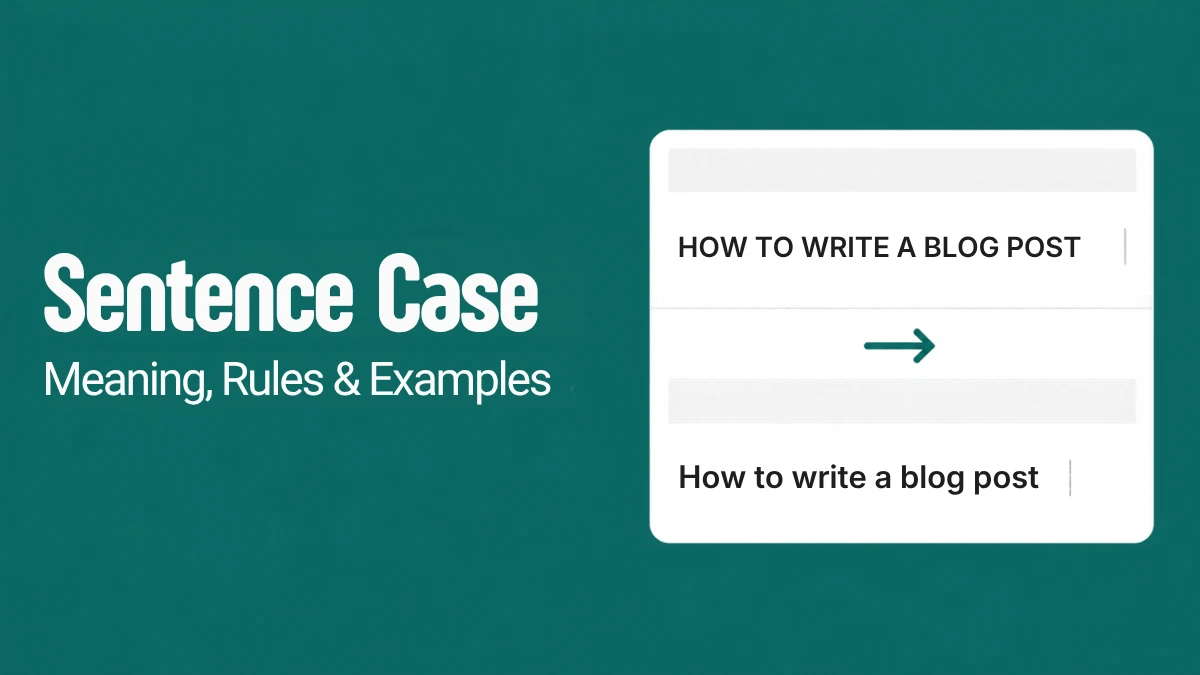
Title case capitalizes most important words in a heading. Sentence case generally capitalizes the first word and proper nouns, using ordinary sentence capitalization for the rest.
7. Can I use a title case converter for blog headings?
Absolutely, a title case converter can help you format your blog titles and headings quickly. But you need to check if the tool’s chosen style matches the requirements, and after that, you should review to avoid any unintended or mistaken results.
8. Which title case style should I use for my website?
Well, it depends on the organization or publication. If no style has been established, choose a clear convention, document it, and apply it consistently across your website’s titles and headings.
Conclusion
Title case is a pretty simple method of making titles and headings visually neat; however, the right way to use it includes doing something more than just capitalizing each word of your title.
First, capitalize major words; second, know the words that normally do not require capitalization; and third, be aware of the roles that prepositions, articles, and conjunctions play in the sentence. Since there are differences in the treatment of certain words between various style guides, consistency and context are as important as the knowledge of basic rules.
If you are going to produce blog posts, web pages, reports, etc., use a title case converter to easily format your texts. Just apply the converter, take a glance over your text, and get your neat titles with no extra effort.
For formatting other types of texts, use the Text and Writing Tools of ToolFlora.
Related Blogs
 Sentence Case: Meaning, Rules, Difference with Title Case, and Examples
Learn what sentence case is, its capitalization rules and examples, and how it differs from title case, plus how to…
 How Many Pages Is 1000 Words? A Complete Words-To-Pages Guide
While writing an essay, school assignment, blog post, report, or script for anything, a question might strike your mind: how…
 Plus minus symbol (±): Meaning, uses, and how to type it.
You may have seen this plus minus symbol somewhere, especially in places related to mathematics, and you must have wondered…