
To convert a percentage to a number, divide by 100, and multiply by the number. For example, to find 20% of 80: (20 ÷ 100) × 80 = 16.

Percentage Calculator
Three quick percentage tools in one. Results update live as you type.
Percentages are everywhere — a discount at the cashier, a test score, a pay raise, a monthly budget — but it’s often easy to get the math wrong when you try to calculate in your head, particularly when the numbers are going up or down. A percent calculator makes it easy to solve common percentage problems, including finding a percentage of a number, determining what percentage one number is of another, and calculating percentage increases or decreases. Simply type in your numbers and receive the result instantly and accurately — it works as both a calculator and percentage checker, so you can confirm a figure someone has quoted you as easily as work one out yourself.
How to use the Percentage Calculator
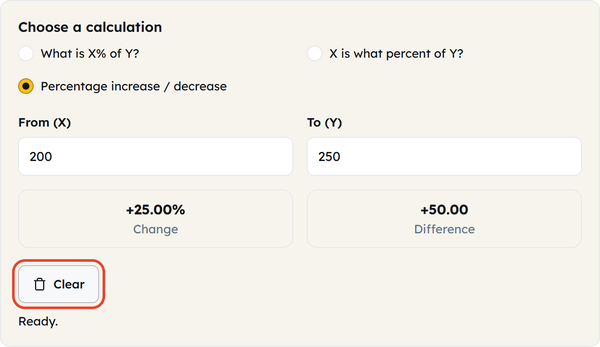
- Select the type of calculation you require: What is X% of Y? X is what per cent of Y? Percentage increase/decrease.
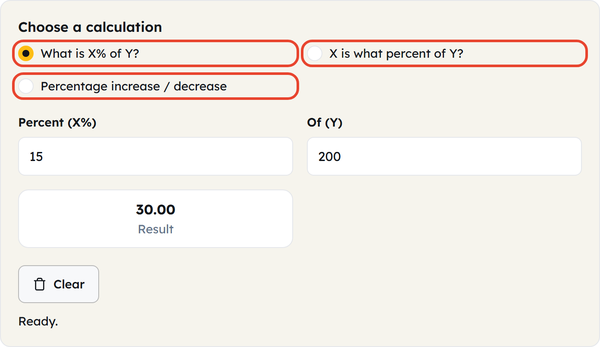
- Enter the required numbers in the fields provided.
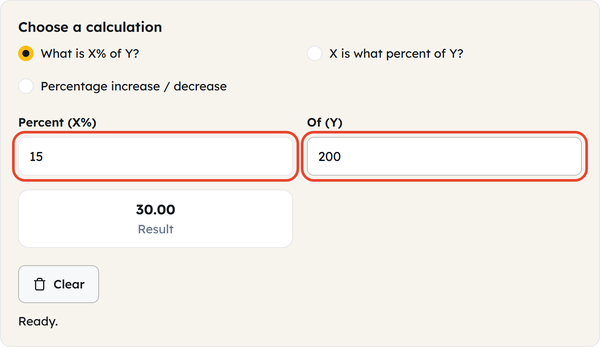
- The result updates automatically as you enter or change the values.
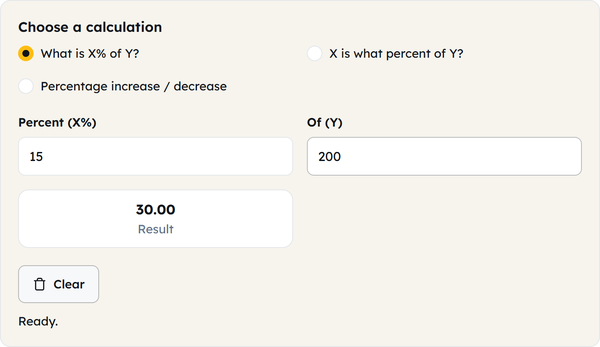
- The tabs at the top allow switching between the three calculators at any time, and each one has its own set of inputs.
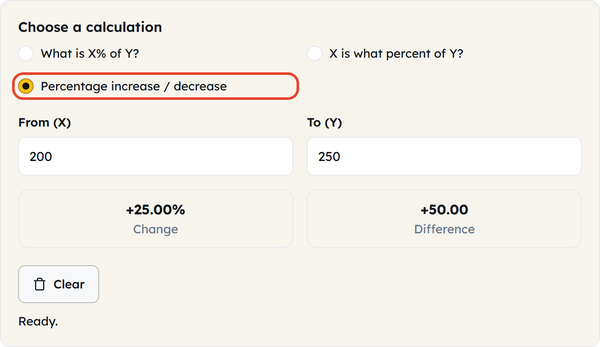
- Clear: To reset a calculator and begin a new calculation.
What is a percentage calculator?
A percentages calculator is a tool that allows you to easily and accurately answer frequently asked percentage questions. As a calculator for percentages it can find a percentage of a number, work out what percentage one number is of another, and find percentage increases or decreases. This tool includes three different formulas:
- What per cent of Y is X? — Divide the number by 100. Example: 20% of 80 → (20 ÷ 100) × 80 = 16.
- To find out what % of Y the part is: Divide the part by the whole and multiply by 100. Example: 15 is what per cent of 60? → (15 ÷ 60) × 100 = 25%.
- Percentage increase/decrease — Difference between old value and new value divided by the old value and multiplied by 100. Positive result indicates increase; Negative result indicates decrease. Example: a price moving from 50 to 65 → (65 − 50) ÷ 50 × 100 = 30% increase.
The percentage change is related to the percentage difference but the order of the numbers is important – percentage change assumes one number is the “original” and the other is the “new” value. Percentage difference, on the other hand, takes both values into account and is applied when there is no apparent before and after.
When you’d use this
When a bill, budget item or investment grows or shrinks over time, calculating the percentage change in the amount; when you are told a percentage but you need to split it or verify it is correct, calculating the percentage; when you are told your grade or exam score, and you need to know how much you earned and how many points are available; when you are shopping for a discount or sale price, figuring out what the discount or sale price is.
Dos and Don’ts
Do:
- Use a calculator in the appropriate mode to answer the question: “X% of Y” and “what per cent of” are different types of problems.
- When working out percentage increase or decrease, remember that the order makes a difference – Make sure to check which number is the ‘original’ value.
- The live-update fields can be used to rapidly test a few scenarios (such as varying discount percentages) without re-entering all of this information repeatedly.
Don’t:
- Take the symmetry of percentage increase and decrease for granted, e.g., a 100% increase from 50 to 100 is followed by a 50% decrease from 100 to 50.
- Mix up percentage points with percentage change, e.g. a 5% increase from 10% to 15% is a 5 percentage-point increase, but a 50% increase in relative percentages.
- “If you are calculating by hand, avoid rounding intermediate results. Round only the final answer when appropriate — small rounding early on can lead to rounding errors that are larger than you expect.
Good to know
Note that percentage increase and percentage decrease are not opposites since they both involve a change in terms of the original value, and not the new value — To differentiate between these two is the #1 place where people get “off track” in math percentage problems, and it is something that needs to be double checked every time the change is in one direction or the other (such as rising prices, price changes, growth measures, etc.). Also, it’s important to note the difference between percentage change and percentage-point change; a 2 percentage-point increase in the interest rate between 10% and 12% is the same as a 20% relative increase, but they answer different questions and are easy to confuse when using them in reports or discussions. This calculator does everything in your browser, there are no downloads, no storage on our servers and no data sent anywhere.
FAQ: Percentage Calculator Questions
How do I calculate a percentage of a number?
How do I find what percent one number is of another?
Divide the part by the whole, multiply by 100. For example, to find what percent 15 is of 60: (15 ÷ 60) × 100 = 25%.
How do I calculate percentage increase or decrease?
To find the percentage change: calculate the difference between the new value and original value, divide the difference by the original value and multiply by 100. If the result is positive, the percentage increase; if the result is negative, the percentage decrease.
What’s the difference between percentage change and percentage difference?
When calculating percentage change, the first value is considered the original and the second value the new, thus the order is important. Percentage difference is an equal consideration of both values and is often used when there is no clear “before” and “after.
Why do my percentage increase and decrease results look different for the same two numbers?
Note that percentage change is a change with reference to the original value and not the new value. The difference between 50 and 100 is the same, but the rate of change from 50 to 100 is 100%, while the rate of change from 100 to 50 is 50%.
Is this percentage calculator free to use?
Yes. It’s free, you don’t have to register anything and it calculates results instantly in your browser.
Related Tools
Password Strength
Score password strength and spot weak patterns.
- 100% Free
- Customizable
- Download
- Unlimited
Age Calculator
Find exact age in years, months, and days.
- 100% Free
- Customizable
- Download
- Unlimited
Date Difference
Measure days between any two dates.
- 100% Free
- Customizable
- Download
- Unlimited
BMI Calculator
Compute body mass index from height and weight.
- 100% Free
- Customizable
- Download
- Unlimited
EMI Calculator
Estimate loan EMI, interest, and total payable.
- 100% Free
- Customizable
- Download
- Unlimited
Discount Calculator
Find sale prices and savings in seconds.
- 100% Free
- Customizable
- Download
- Unlimited